When Can You Put Car Seat Forward Facing? A Guide
You’re probably wondering when can you put car seat forward facing, and honestly, it’s one of the most common questions we hear from parents. The short version is: wait until your child is at least 2 years old, and ideally much longer.
The American Academy of Pediatrics (AAP) recommends keeping kids rear-facing for as long as possible within the seat’s height and weight limits. As of 2026, that guidance remains unchanged. Most convertible car seats allow rear-facing up to 40 to 50 pounds, which means many toddlers can safely ride backward well past their third birthday.
Let’s break down what the laws say, what the science supports, and how you’ll know when your child is truly ready.

Image source: Bing (Web (fair-use with source credit))
Quick Answer: The Short Version Every Parent Needs
Most states set the minimum at age 2. That’s the legal floor, not the safety ceiling. The AAP says keep kids rear-facing as long as possible.
Most convertible seats allow rear-facing up to 40 to 50 pounds. When in doubt, leave them rear-facing.
Why This Decision Matters More Than You Think
Turning your child around too early is one of the biggest safety mistakes parents make. The reason comes down to anatomy. Young children have heavy heads and still-developing neck and spine bones.
In a crash, a forward-facing seat lets the harness catch the body, but the head and neck snap forward with tremendous force.
Rear-facing seats cradle the entire body, including the head and neck, across the whole seat shell. That distributes crash forces along the back and neck. The result is a dramatically lower risk of serious head, neck, and spine injuries.
The AAP has been clear on this for years. Keep children rear-facing until at least age 2, and ideally longer. State laws are slowly catching up, but many still lag behind the science.
Understanding the difference between what’s legal and what’s safest could change how you approach this decision entirely.
Rear-Facing vs Forward-Facing: What the Safety Data Actually Shows
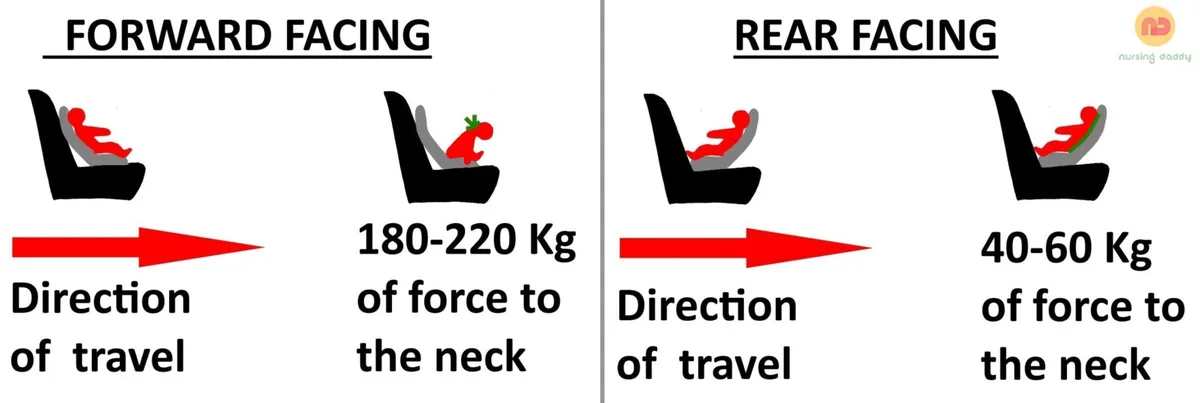
Image source: Bing (Web (fair-use with source credit))
The crash physics here are pretty straightforward. When a vehicle hits something, the child’s body keeps moving forward at the vehicle’s original speed. A rear-facing seat intercepts that motion differently than a forward-facing one.
In a rear-facing seat, the child is pushed into the seat shell. The shell absorbs the impact across the entire back, head, and neck. In a forward-facing seat, the harness catches the shoulders and chest, but the head keeps going.
That leaves the neck to absorb the energy.
| Crash force | Rear-facing | Forward-facing |
|---|---|---|
| Head and neck | Supported by the seat shell | Moves forward against the harness |
| Spine | Stays aligned and supported | Flexes forward sharply |
| Injury risk | Lower for head, neck, and spine | Higher for head, neck, and spine |
Crash testing data from the National Highway Traffic Safety Administration confirms this pattern. The difference is even more pronounced for younger children. A 1-year-old’s head is about 25% of their body weight.
For an adult, it’s roughly 6%. That heavy head on a fragile neck is a serious risk in a forward-facing crash.
The takeaway isn’t complicated. Rear-facing is safer. It stays safer until your child physically outgrows the seat’s rear-facing limits.
That’s why babies sitting forward is something parents should delay, not rush.
The Minimum Legal Requirement vs. the Safest Practice
Here’s where things get confusing. The law says one thing, and safety experts say another. The minimum legal age for forward-facing is 2 in most states.
That means it’s legal to turn your child at 2. But legal doesn’t mean safest.
The AAP’s official guidance is to keep children rear-facing until they exceed the height or weight limit of their convertible car seat. For many seats, that’s 40 to 50 pounds. A typical 4-year-old weighs around 36 to 40 pounds.
So plenty of kids can safely stay rear-facing well past their third birthday.
State laws are minimums. They’re not best practices. They’re the absolute floor for what’s allowed, not a recommendation for what’s optimal.
If your state says 2 and your child is 2, you’re legal. But you’re not doing them any favors by flipping the seat early.
This is why turning your car seat around causes so much confusion. Parents hear “age 2” from one source and “as long as possible” from another. The safest answer is almost always the longer one.
The legal answer is just the boundary you can’t cross below.
How to Know If Your Child Is Physically Ready (Height, Weight, and Harness Fit)
Before you even think about flipping the seat, check three things. First, your child’s height. Second, their weight.
Third, whether the harness straps still fit correctly.
Check the car seat label first. Every convertible seat has a printed label with the rear-facing height and weight limits. If your child has outgrown those numbers, forward-facing is the only option.
If they haven’t, keep them rear-facing.
The harness straps are the next clue. When rear-facing, straps should sit at or below the shoulders. When forward-facing, they need to be at or above the shoulders.
If the straps are already sitting above your child’s shoulders while rear-facing, that’s a clear sign they’ve outgrown that mode.
Here’s a quick checklist:
- Is your child within the label’s rear-facing height and weight limits?
- Do the harness straps sit at or below the shoulders when rear-facing?
- Does your child still have at least 1 inch of headroom above the top of the seat?
- Is your child under the maximum rear-facing weight printed on the label?
If you answered no to any of these, it might be time to flip. If you answered yes to all of them, keep them rear-facing. There’s no prize for early flipping.
The only goal is keeping your kid safe.
Also, review the forward facing requirements for your specific car seat model. Different seats have different limits. Don’t assume your neighbor’s seat rules apply to yours.
And if you’re still unsure about the right age, our guide on front-facing car seat timing walks through the milestones in more detail.