When Can Your Child Switch to a Forward Facing Car Seat
If you’re asking what age for a forward facing car seat, you’re probably staring at a growing toddler and wondering when to make the switch. It’s one of the biggest safety milestones in the early years. And the honest truth?
There isn’t one magic number that fits every child.
The American Academy of Pediatrics recommends keeping kids rear‑facing until at least age 2, but ideally until they max out the rear‑facing limits of the specific seat they’re in. Crash data backs this up: children rear‑facing past their second birthday are roughly 75% less likely to suffer serious injury. Let’s walk through the decision step by step so you know exactly when it’s time to turn.
Quick Answer
The answer to “what age for a forward facing car seat” is at least 2 years old, and only after your child exceeds the rear‑facing weight or height limit on their specific car seat. State minimums often say 1 year and 20 pounds, but safety guidelines and crash data prove waiting is much safer. Always follow your seat’s manual over the state minimum.
So, When Is My Kid Ready for a Forward-Facing Seat?
This is the question that keeps parents up at night. You want a clear number, a rule you can tell the daycare or the in-laws. Something to circle on the calendar.
Car seats don’t work that way. Safety isn’t a date. It’s a three‑part checklist that depends on the specific child and the specific seat.
The checklist asks: has your child outgrown the rear‑facing limits of their seat? Do they meet the state’s legal minimum? And are they physically mature enough to sit correctly forward‑facing?
We cover each one below.

The One Rule That Overrules Every State Law
State minimums exist. But they are the absolute floor, not the safety ceiling. The real rule that matters is printed right on your car seat.
Every seat sold in the US has a sticker that lists the rear‑facing weight and height limits. Look for that sticker on the side of the shell. If your child still falls within those rear‑facing numbers, they are not ready to turn around.
Period.
Your state may legally allow a 1‑year‑old to ride forward‑facing. But the seat manufacturer is saying the seat itself is physically designed to protect a much larger child in the rear‑facing position. The manufacturer’s limits are the real limits.
Think of it this way: state law is the minimum. The seat’s sticker is the maximum. Your safest move is always to stay rear‑facing until you hit that maximum.
Your 3-Step Workflow for Turning Forward-Facing
This workflow is your decision tree. Follow these three steps in order. If you fail any of the first two, the answer is “not yet.”
Step 1: Check the Seat’s Exact Limits
Go to your car seat right now. Find the sticker. It is usually on the side of the shell or on the back near the recline foot.
Write down the maximum rear‑facing weight and height.
Now weigh your child and measure their height accurately. Use a bathroom scale and a tape measure on the wall. If they are below both those numbers, they should stay rear‑facing.
Full stop.
Many modern convertible seats allow rear‑facing up to 40 or even 50 pounds. A typical 2‑year‑old weighs around 25 to 30 pounds. That means most kids have plenty of room to keep riding backward safely.
Even a tall 3‑year‑old often fits well within the rear‑facing height limit of a 40‑pound convertible seat.
Do not guess. Do not rely on “feeling” like they’re too big. The sticker has the actual numbers.
Trust the sticker.
Step 2: Check Your State’s Minimum Rule
After you’ve confirmed your child has outgrown the rear‑facing limits of the seat, check your state law. Some states require rear‑facing until age 2. Others only require it until age 1 and 20 pounds.
The NHTSA website maintains a list of every state car seat law. A quick search for “[your state] car seat law” works too.
But remember: meeting the state minimum is the legal bare minimum. It is not the safety best practice. If your child barely meets the state minimum but still has room in the rear‑facing limits of their seat, the science says to wait.
The state minimum is there to catch the worst cases. It is a floor, not a target. Aim for the ceiling of your seat’s limits.
Step 3: Check Your Child’s Readiness
This step is the maturity check. Forward‑facing requires enough neck strength and trunk control to handle the crash forces we just described.
Can your child sit upright in a chair for extended periods without slumping? Do they have consistent head control? Can they follow basic instructions?
A child under 2 almost never meets this maturity threshold. Even many 2‑year‑olds slump or fall asleep in a way that puts their head out of position in a forward‑facing seat. That is dangerous because the head whipping forward in a crash is what we’re trying to avoid.
Look for the “sitting test.” When your child is sitting in a regular chair, can they stay upright without flopping over for the duration of a typical car ride? If not, they are not ready.
The Crash Physics: Why Waiting is Worth It
Let’s talk about what actually happens in a crash. This is where the fear of turning early gets real.
In a frontal crash, the most common and most severe type, a forward‑facing child’s body is held by the harness. But their head whips forward violently. For a toddler whose skeleton is still mostly cartilage and whose neck muscles are weak, that force can cause internal decapitation: a spinal cord injury at the top of the neck.
A rear‑facing child is cradled by the seat shell. The crash force is distributed across the entire back, head, and neck. The head does not snap forward.
The risk of catastrophic neck injury drops dramatically.
Crash test footage makes this difference obvious. The forward‑facing dummy’s neck stretches like a rubber band. The rear‑facing dummy stays contained in the shell.
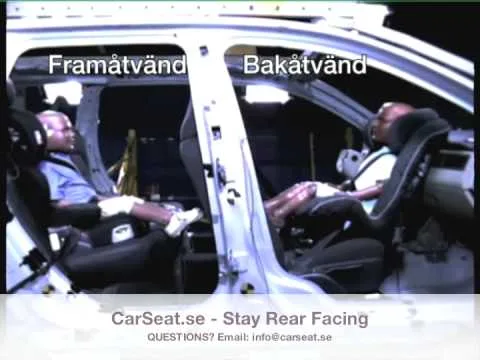
This is why the AAP, NHTSA, and every major safety organization recommend extended rear‑facing. It is not about leg room or convenience. It is about protecting the spinal column during its most vulnerable developmental stage.
The “He’s Old Enough!” Trap (Why Minimum Isn’t Best)
You will hear this from well‑meaning family members, friends, and even some daycares: “He’s one! Turn him around! His legs are cramped!”
Let’s address the most common pressures and why they fall short.
“His legs are too long.”
Kids are incredibly flexible. They sit cross‑legged, put their feet up on the vehicle seat, or dangle them over the sides of the seat. There is no evidence that rear‑facing causes leg injuries.
In fact, the legs taking the direct force in a forward‑facing crash are more likely to break because they are the first point of impact with the vehicle seat.
“He’s the same size as his cousin who is forward‑facing.”
Every seat has different limits. The cousin might have a seat with a lower rear‑facing weight limit, like a seat that maxes out at 30 pounds rear‑facing. Or the parents turned early based on state law alone.
You cannot compare two families without looking at the specific seat stickers.
“The state law says 1 year and 20 pounds.”
State laws are updated slowly. Many were written when car seats had much lower limits and the science was less advanced. The crash data is clear: state minimums are the absolute floor, not the safety ceiling.
“Daycare requires a forward‑facing seat.”
This is a tough conflict. If your daycare’s transportation policy forces an early turn, you have a hard choice. Our advice: find a daycare that supports extended rear‑facing, or use your own car for drop‑off and pickup.
A child’s safety is worth the logistical inconvenience.
“He cries facing backward.”
Crying is frustrating, but it doesn’t create a safety risk. Often, a mirror so the child can see you, or a window shade, solves the problem. Turning early because of crying is giving in to a temporary annoyance at the expense of long‑term safety.
But What About Their Legs? (Spoiler: They’re Fine)
This is the number one reason parents turn early. A 2‑year‑old’s legs touch the back of the vehicle seat. They look squished.
It feels wrong.
Here’s what the crash data says: legs are not in danger rear‑facing. Kids are contortionists. They cross their legs, prop them up on the seat back, or dangle them over the sides of the car seat shell.
They never sit the same way twice.
In a forward‑facing crash, the legs fly forward and hit the vehicle seat first. That is where real leg fractures happen. Rear‑facing, the legs are cradled and move with the body.
No evidence shows higher leg injury rates for rear‑facing kids.
The American Academy of Pediatrics explicitly states that legs touching the seat back is normal and not a reason to turn. Your child is comfortable. They are not complaining.
Trust their flexibility, not your adult perception of cramped.
Real Talk: When You Actually Should Turn Early
Extended rear‑facing is best. But there are valid reasons to consider turning earlier than the seat’s absolute limits.
Your child has outgrown the rear‑facing height or weight limit of the seat. This is the only non‑negotiable reason. If the top of your child’s head is within one inch of the top of the seat shell, or if they exceed the weight limit printed on the sticker, you must turn. That is physics, not preference.
Rare medical needs. If a child has severe reflux that requires more upright positioning, or a condition that makes rear‑facing dangerous (like certain airway issues), a doctor may recommend forward‑facing earlier. This should be a written recommendation, not a casual suggestion.
Daycare or school transportation requirement. We already said this is a tough conflict. If you absolutely cannot avoid it, turn at the absolute minimum your state and seat allow. But exhaust every other option first.
For everyone else: wait. The discomfort, the crying, the leg room complaints. None of those are valid safety reasons.
The crash physics we covered earlier does not care about convenience.
Your “Yes or Not Yet” Decision Guide (Follow This Path)
Let’s make this simple. Follow this flow.
Step A: Check the sticker. Is your child under the rear‑facing weight AND height limit on the seat?
- If yes: do not turn forward‑facing. You are done reading.
- If no: proceed to Step B.
Step B: Check your state law. Does your state have a minimum age or weight requirement you must meet?
- If you meet it: proceed to Step C.
- If you don’t meet it: keep rear‑facing until you do.
Step C: Check maturity. Can your child sit upright with good head control for the duration of a ride? Do they consistently hold their head up without slumping?
- If yes: you can turn forward‑facing, but consider waiting if your child has not reached age 2.
- If no: keep rear‑facing until they develop that control.
Use this table as a quick reference:
| Condition | Decision |
|---|---|
| Child under rear‑facing weight & height limits | Keep rear‑facing |
| Child exceeds rear‑facing limits | Turn forward‑facing |
| State law requires rear‑facing (e.g., until age 2) | Follow state law |
| Child under 2 but meets seat limits | Strongly recommended to wait until at least 2 |
| Child over 2, meets seat limits, good head control | Safe to turn |
The safest path: rear‑face until your child maxes out the seat’s rear‑facing limits, even if that means age 3 or 4. Many convertible seats allow rear‑facing up to 50 pounds. A 4‑year‑old can often still ride backward safely.
Frequently Asked Questions
What is the minimum age for forward‑facing car seat?
State minimums vary, but the safest answer is age 2. The AAP and NHTSA recommend rear‑facing until at least age 2 or until the child outgrows the seat’s rear‑facing limits. Turning at age 1 is legal in many states but not recommended.
Can my 1‑year‑old sit forward‑facing legally?
In most states, yes. The typical law is 1 year and 20 pounds. However, safety guidelines say to wait.
Check your specific state law. The NHTSA state law database has the full list.
My child’s legs touch the back seat. Does that mean they need to turn?
No. It is normal. Children are flexible and comfortable sitting cross‑legged or with feet against the seat.
Leg contact does not increase injury risk and is not a reason to turn forward‑facing.
What happens if I turn my child forward‑facing too early?
The primary risk is catastrophic neck injury in a crash. A forward‑facing toddler’s head whips forward, putting extreme force on an immature spine. Extended rear‑facing reduces that risk by up to 75 percent.
Do I need a new car seat when I turn forward‑facing?
Not if you have a convertible, combination, or all‑in‑one seat. These seats convert to forward‑facing mode. Check the manual to see if any parts (like the recline wedge) need to be removed or adjusted for forward‑facing installation.
How do I install a forward‑facing car seat correctly?
Secure the seat with either the seat belt or LATCH system (check weight limits for LATCH). Always use the top tether. The harness must be at or above the child’s shoulders.
Refer to your car seat manual and installation guide for exact steps.
The Takeaway
The answer to what age for a forward facing car seat is not a simple number. It depends on your child’s size, your specific seat’s limits, and your state law. The safest approach: keep rear‑facing until your child maxes out the limits of the seat, even if that means age 3 or 4.
Do not turn because of leg room, pressure from family, or state minimums. Turn because your child literally no longer fits rear‑facing according to the manufacturer’s sticker. Trust the sticker over the gossip.
The data is clear. Extended rear‑facing saves lives. Every extra month backward is a month of dramatically reduced crash risk.
Your child’s spine will thank you.