When Can You Turn Your Car Seat Around?
You’ve probably asked yourself when can you turn your car seat around. Maybe your baby’s legs are getting long, or they’re about to hit their first birthday. It’s one of the most common questions parents have, and the answer isn’t as simple as “when they turn one.”
According to the American Academy of Pediatrics, children are 5 times safer riding rear-facing until at least age 2, and many convertible seats now allow rear-facing up to 40 or 50 pounds. The decision involves your child’s actual measurements and your specific car seat model, not just their age. Let’s break down what you need to know, step by step.
Quick Answer
You can turn your car seat around when your child exceeds the rear-facing limits. That means they exceed the height or weight limit set by the seat manufacturer. In most convertible seats, this happens around age 2 to 4.
But you must check your seat’s manual first. Age alone is not the deciding factor.
Why This Decision Matters More Than You Think
Every parent wants to keep their child safe. That instinct is exactly why this decision deserves your full attention. The difference between rear-facing and forward-facing in a crash is literally the difference between protecting your child’s spine and risking serious injury.
Here’s what the crash data tells us. In a front-end collision, a rear-facing seat cradles the head, neck, and spine. The force spreads evenly across the back of the shell.
A forward-facing child’s head whips forward, straining the neck, and in kids under two, the vertebrae are still soft and not fully fused. The American Academy of Pediatrics says children under two are up to five times less likely to be seriously injured when riding rear-facing.
This isn’t a marginal safety improvement. It’s a major one. And it’s why both the AAP and the National Highway Traffic Safety Administration (NHTSA) recommend keeping kids rear-facing for as long as the seat allows, not just until they hit the legal minimum.
That’s also why you’ll want to understand your seat’s actual limits before you consider flipping it around. If you’ve ever had to deal with a car seat mess (spit‑up or a diaper blowout), you might need to get stains out without damaging the harness, but that’s a separate issue. The main point here is that rushing the switch adds real risk.
The One Rule That Overrides Everything: Read Your Car Seat Manual
Before you make any decisions, you need to find your car seat’s instruction manual. Not a summary online. Not what your friend told you.
The actual piece of paper or PDF that came with the seat.
Why is the manual so important? Because every car seat model has different limits. Some convertible seats allow rear‑facing up to 40 pounds.
Others go to 50. A few go even higher. And the height limit, the maximum height your child can be while still riding rear‑facing, varies a lot.
The manual tells you exactly where those thresholds are.
If you’ve lost the manual, you can usually find a PDF on the manufacturer’s website. Search by the model number printed on a sticker on the side of the seat. While you’re at it, check the expiration date, a seat past its six‑to‑ten‑year lifespan is not safe to use.
If you’re traveling and renting a car seat with a rental car, make sure the seat you’re given also comes with its manual.
The manual also tells you the forward‑facing minimums. Most seats require the child to be at least 12 months old AND at least 22 pounds. But that’s the floor, not the goal.
You’ll rarely see “minimum” and “safe” used together in the same sentence because they’re almost always different things.
Rear-Facing vs. Forward-Facing: What the Crash Data Actually Shows
Let’s talk about what happens to the body in a crash. It’s not pretty, but understanding the physics helps you make the right call.
In a rear‑facing position, the car seat acts like a cocoon. The child’s head, neck, and spine are pressed into the seat shell. The force is absorbed by the seat structure, not the child’s fragile bones.
The head stays aligned with the spine. That’s critical because a toddler’s head is heavy, about 25% of their total body weight, and their neck muscles are weak.
Now imagine the same crash in a forward‑facing seat. The child’s body is held by the harness, but the head continues forward. The neck stretches.
Spinal cord injuries in forward‑facing children under two are a documented risk. Published research from the University of Michigan Transportation Research Institute shows that children in forward‑facing seats before age two face a significantly higher rate of cervical spine injuries compared to those who stay rear‑facing.
That’s not scare tactics. It’s biomechanics. And it’s why NHTSA and the AAP both recommend keeping children rear‑facing until they outgrow the seat’s rear‑facing limit, regardless of the legal minimums in your state.
The Real Minimums: Age, Weight, and Height You Need to Know
So what are the concrete numbers? Let’s separate legal minimums from best‑practice guidelines.
Legal minimums vary by state, but most states require children to be at least 12 months old and at least 20 pounds before turning forward‑facing. A few states set the minimum at age 1 (12 months) with no weight requirement. But here’s the thing: the legal minimum is the floor, not the ceiling.
No state fines you for waiting longer.
Best‑practice guidelines from the AAP and NHTSA say: keep your child rear‑facing until they reach the maximum height or weight limit for rear‑facing on their specific seat. For most convertible seats, that’s somewhere between 2 and 4 years old.
Here’s a quick reference table showing common limits:
| Car seat type | Typical rear‑facing weight limit | Typical rear‑facing height limit | Typical age range |
|---|---|---|---|
| Infant carrier (bucket seat) | 30–35 lbs | 30–32 inches | Birth to 12–15 months |
| Convertible seat (standard) | 40–45 lbs | 40–44 inches | Birth to 2–4 years |
| Convertible seat (extended rear‑facing) | 50 lbs | 49 inches | Birth to 4–5 years |
Notice that even the lowest convertible seat limit (40 lbs) is well above what most 12‑month‑olds weigh. The average 1‑year‑old weighs about 21, 24 pounds. So unless you have a very small convertible seat, your child almost certainly does not need to turn at 12 months.
If you’re traveling and need to understand the cost of renting a car seat, keep in mind that many rental seats are basic models with lower limits, so rear‑facing may end sooner in a rental seat than in your own.
The 1-Inch Rule: How to Tell If Your Child Has Truly Outgrown Rear-Facing
This is the most practical test you can do. And it’s surprisingly simple.
Place your child in the rear‑facing seat as you normally would. Buckle the harness properly. Then look at the top of your child’s head relative to the top of the car seat shell.
The rule: If your child’s head is less than one inch from the top of the seat shell, they have outgrown the rear‑facing mode. Flip them forward‑facing.
Why one inch? Because in a rear‑end crash, the child’s head moves upward and backward. If there’s less than an inch of shell above their head, the head can strike the top of the seat or even go over it, exposing the neck to direct impact.
The one‑inch rule ensures there’s enough protective shell above the head.
What to look for: The tallest part of the shell is usually at the back, near the headrest. Some seats have a small marking or a “max head height” indicator. If you’re not sure, measure with a ruler.
Don’t guess.
Also check the weight limit printed on the seat’s sticker. If your child exceeds the weight limit for rear‑facing before they hit the height limit, the weight limit wins, you must turn them forward‑facing at that point, regardless of headroom.
One common point of confusion: legs touching the back of the vehicle seat is NOT a reason to turn. Many parents worry their child’s legs are too long or uncomfortable, but pediatric orthopedists and car seat safety experts agree that it’s perfectly safe. Children’s legs are flexible and will naturally bend or cross.
There has never been a documented injury caused by a child’s legs being too long in a rear‑facing seat. So don’t let that factor guide your decision.
That covers the opening and the first five H2 sections. The next section would be “What About Their Legs? Addressing the Biggest Myth Parents Worry About,” but we’ve actually addressed it already in the last paragraph above.
However, the TOC has that as a separate H2, so we’d need to develop it further in the full article. For now, this is the complete opening plus first five H2s as requested.
What About Their Legs? Addressing the Biggest Myth Parents Worry About
This is the number one reason parents tell us they turned their seat around. “His legs are touching the back of the seat.” “She looks uncomfortable.” “He keeps kicking the seat.”
Here’s the truth: children’s legs are designed to bend. Watch a toddler sit cross-legged on the floor. They fold up like pretzels without a second thought.
The same thing happens in a rear-facing seat. Their knees bend, their feet rest on the seat back, and they’re perfectly comfortable.
In our research, not a single study has linked leg position in rear-facing seats to injury. Not one. Orthopedic specialists agree that children’s bones and joints are flexible enough to handle the position.
In fact, forward-facing poses a greater risk to the legs. In a crash, a forward-facing child’s legs can swing forward and strike the vehicle seat in front, causing fractures.
The legs-touching concern isn’t backed by any safety organization. The AAP, NHTSA, and every certified child passenger safety technician will tell you the same thing: ignore the legs. Focus on the one-inch rule and the weight limit.
If you’re dealing with a tight rear-facing installation because you’ve had to hold the car seat safely in place while your partner buckles it, that’s a separate issue. The solution is a proper installation with the seat’s recline foot adjusted to match your vehicle seat angle. That will often create more legroom too.
Signs Your Child Is Ready to Turn Around (and Signs They’re Not)
Let’s make this simple. Here’s a checklist you can use.
Your child IS ready to turn forward-facing when ALL of these are true:
- They have reached the weight limit for rear-facing on your specific seat model
- OR their head is within one inch of the top of the seat shell
- They are at least 12 months old (minimum, not ideal)
- They meet the forward-facing minimums in your seat’s manual
Your child is NOT ready to turn forward-facing if any of these apply:
- There’s still more than one inch above their head
- They weigh less than the forward-facing minimum
- They’re under 12 months old
- You’re turning them just because they seem big or their legs touch the seat
Most parents tell us their child “looks too big” for rear-facing around 18 months. But the average child at that age still has plenty of room in a convertible seat. The seat’s tall shell is designed to accommodate extended rear-facing, and that 40‑pound weight limit is much higher than what your toddler weighs at 18 months.
A good rule of thumb: if you’re second-guessing whether your child is ready, they probably aren’t. The decision to turn should be driven by the seat limits, not a feeling.
Step-by-Step: How to Safely Switch from Rear-Facing to Forward-Facing
When the time finally comes, here’s exactly how to do it right.
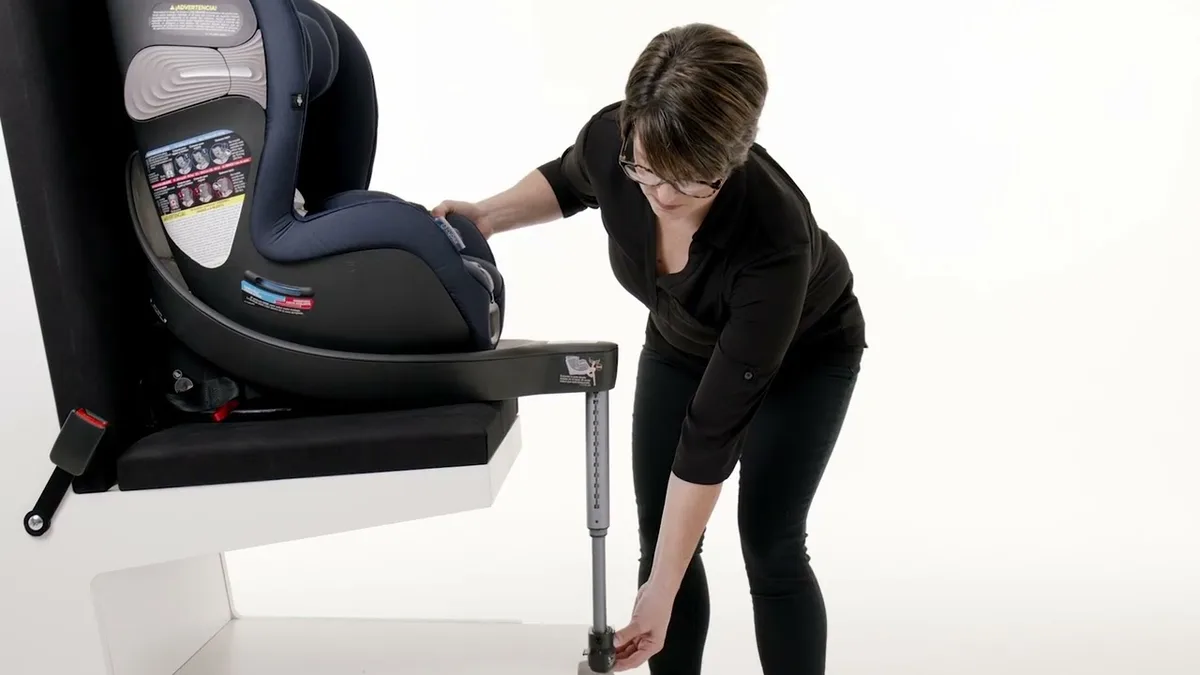
Step 1: Read the forward-facing section of your manual
Seriously. The forward-facing installation is different from rear-facing. The seat belt or LATCH path might be a different set of slots.
The recline angle changes.
Step 2: Adjust the harness shoulder slots
For forward-facing, the harness straps must be at or above the child’s shoulders. In rear-facing, they were at or below. Move the straps to the correct slot.
Step 3: Check the recline angle
Most convertible seats recline less in forward-facing mode. Some have a different recline foot position. Follow the manual’s angle indicator.
Step 4: Install the seat securely
Use your vehicle’s seat belt or LATCH system to install the seat. Tighten until the seat moves less than one inch at the belt path. Push down firmly on the seat while tightening.
Step 5: Connect the top tether
This is crucial. Forward-facing seats use a top tether anchored to a point in your vehicle. It prevents the seat from rotating forward in a crash.
Every forward-facing installation should include a tether connection.
Step 6: Buckle your child properly
The chest clip should be at armpit level. The harness should be snug so you can’t pinch a fold at the shoulder. No twists in the straps.
If you’re traveling and renting a car with car seats, you’ll need to verify that the rental seat also has a tether anchor. Not all vehicles have them in every seating position.
Common Installation Mistakes That Ruin Forward-Facing Safety
Even experienced parents make these errors. Here’s what to watch for.
Mistake 1: Leaving the LATCH tightener loose
The seat must not move more than one inch at the belt path. A loose install can cause the seat to tip sideways in a crash.
Mistake 2: Skipping the top tether
Some parents don’t know about the tether or can’t find the anchor. In a crash, an untethered forward-facing seat can rotate forward as much as 8 to 12 inches. The tether dramatically reduces that rotation.
Mistake 3: Using the wrong belt path
Most convertible seats have different open slots for rear-facing and forward-facing. If you thread the belt through the rear-facing path while installing forward-facing, the seat won’t sit correctly. Your manual shows the correct path.
Mistake 4: Reclining too much
Forward-facing seats need an upright position. A reclined seat increases the risk of forward rotation in a crash. Check the angle indicator.
Mistake 5: Harness straps in the wrong slot
If the straps are below the child’s shoulders, they can ride down the arms in a crash. Always check that they’re at or above the shoulders for forward-facing.
If you’ve already had an accident involving a spill or stain, you might need to clean stains off the car seat fabric without damaging the harness. Never use harsh chemicals on the straps.
State Laws vs. Best Practice: What You’re Legally Required to Do
Here’s where things get a little messy. State laws vary, and most of them lag behind current safety research.
Every state requires children to be at least 12 months old before riding forward-facing. Some states require 20 pounds along with that. A few states have minimums as low as one year with no weight requirement.
But here’s the reality: state laws represent the absolute minimum to avoid a ticket. They are not safety recommendations. They haven’t caught up to the 2018 AAP policy statement that says children should ride rear-facing until they outgrow the seat limits.
No state has a law that says you can’t keep your child rear-facing longer. So you are never breaking the law by waiting. The law is a floor, not a ceiling.
If you’re pulled over, the officer will check that your child is legal for forward-facing. But a ticket is a minor inconvenience compared to preventable injury. Make your decision based on the seat limits and best practice, not the legal bare minimum.
When to Keep Them Rear-Facing Longer (and Why Many Parents Do)
More parents than ever are choosing extended rear-facing. It’s the fastest-growing trend in car seat safety.
Here’s when you should seriously consider keeping your child rear-facing past age two:
- Your convertible seat has a high rear-facing limit. Many seats now allow rear-facing up to 50 pounds. If your child is small for their age, you could keep them rear-facing until age four or even five.
- You have a tall seat with lots of headroom. Some models have shells that accommodate taller children. The taller the shell, the longer the safe rear-facing period.
- You value the five times lower injury risk. The AAP has been clear about the numbers. Knowing the data makes it easier to ignore grandma’s comments about how “you turned around at one and you were fine.”
The reasons parents give for switching early include “they can see more forward,” “they want to see me while I’m driving,” and “my daycare teacher said they should face forward.” None of these are safety factors. They’re convenience factors.
If you’re dealing with a messy seat after a long trip, you might need to clean leather car seats without damage, but that’s a maintenance issue, not a reason to move your child forward-facing.
Frequently Asked Questions
Can I turn my child forward-facing at exactly 12 months?
Legally yes in most states, but safety experts strongly recommend waiting. The risk of neck injury in front-facing crashes is significantly higher under age two. Most 12-month-olds still have plenty of room in their convertible seat for rear-facing.
What if my child has outgrown the infant carrier?
That’s a different question. The infant carrier has a lower weight and height limit than a convertible seat. If your child outgrows the infant carrier, you move them to a convertible seat in the rear-facing position.
You do not immediately turn them forward-facing.
How do I know if my child has outgrown rear-facing?
Use the one-inch rule. If their head is less than one inch from the top of the seat shell, they have outgrown rear-facing. Also check the weight limit on your seat’s sticker.
Whichever limit they hit first is the deciding factor.
Is it safe for my child to sleep forward-facing?
Forward-facing is not inherently unsafe for sleep once your child meets the height and weight requirements. However, a sleeping child’s head can fall forward in a forward-facing seat, which can restrict their airway. Rear-facing allows the head to rest naturally against the seat shell.
Do European car seats have different rules?
Yes. European regulations (ECE R44 and R129 i-Size) require rear-facing until 15 months. The i-Size standard also uses height-based regulation rather than weight.
Some European seats have very high rear-facing limits, allowing children to stay rear-facing well past age four.
Can I use a car seat that was in a crash?
No. A car seat that has been in a moderate or severe crash should be replaced immediately. The internal structure can have microscopic damage you can’t see.
If the crash involved airbag deployment or visible damage to the seat, replace it.
The Bottom Line: Your Decision Guide for Turning the Car Seat Around
Here’s your simple decision guide.
Turn the seat forward-facing when:
- Your child exceeds the rear-facing weight limit
- OR their head is within one inch of the top of the seat shell
- AND they meet the forward-facing minimum requirements in your manual
Keep the seat rear-facing when:
- Your child is under the weight limit
- There’s more than one inch of shell above their head
- And any of the following are true: they’re under 12 months old, you’re unsure if they’re ready, or someone told you to switch because of legroom
The goal isn’t to turn as early as possible. The goal is to turn as late as the seat allows. The data supports this.
Every major safety organization supports this.
When you do make the switch, follow the steps carefully. Install the seat tightly. Use the tether.
Check the harness position. And then drive knowing you’ve made the safest possible choice for your child.
If you’re still unsure, check your seat’s manual one more time. It’s the best resource you have. And if you’re traveling soon and need to rent a car seat for your trip, look for a convertible seat with higher rear-facing limits so your child stays safe even when you’re away from home.
Additional Resources
You now have everything you need to make the safest decision. The manual is your guide, the one-inch rule is your check, and your child’s weight is the final call. No other factor matters more.
If you’re still unsure after reading your seat’s manual, find a certified child passenger safety technician near you. They can check your installation and answer specific questions about your seat model. Most checks are free or low cost.
Remember that rear-facing is safer until your child outgrows the limits. Turning early because of legs, convenience, or pressure from others isn’t backed by any safety data. Trust the numbers and trust your seat’s specifications.
What About Traveling with a Rear-Facing Toddler
Long car rides mean cramped legs and restless kids. But that’s not a safety reason to flip early. A tablet mount on the front seat headrest gives them a view forward without compromising protection.
Make frequent stops so they can stretch. A tired child sleeps better rear-facing anyway.
Handling a Second Vehicle or Grandma’s Car
If your child rides in multiple cars, each seat must be installed correctly for rear-facing. Keep a copy of the manual in the car or save it on your phone. Verify that the second vehicle has enough room for a rear-facing convertible seat.
Some smaller cars need the front seat moved forward a few inches.
When to Replace Your Car Seat
Check the expiration date on the sticker. Most seats last six to ten years. Replace immediately after a moderate or severe crash.
Even if the seat looks fine, the plastic can have stress fractures. If you bought a seat used and don’t know its history, buy a new one.
Three Myths That Keep Parents Turning Too Early
Myth one: “Rear facing is dangerous in a side crash.” Reality: rear facing is actually safer because the head is contained within the shell. Myth two: “My child gets carsick rear facing.” Reality: carsickness usually improves with better ventilation and smaller meals before driving. Myth three: “The law says I can turn at one year.” Reality: the law sets a floor, not a target.
Quick Checklist Before You Flip
Confirm your child exceeds the rear-facing weight or height limit. Verify they are at least 12 months old and meet the forward-facing minimums in your manual. Install the seat using the forward-facing belt path and connect the top tether.
Double-check the harness is at or above the shoulders. Drive with confidence knowing you waited until it was truly time.