When Can Kids Sit in the Front Seat? Age Rules
You’re probably wondering when can kids sit in front seat of car, and the answer is a lot more layered than a single birthday. Most parents hear “13 years old” and assume that’s the magic number, but the real decision depends on height, weight, seat belt fit, and your state’s laws.
The National Highway Traffic Safety Administration (NHTSA) recommends keeping all children under 13 in the back seat regardless of their size. Crash data shows front airbags can seriously injure smaller passengers. Let’s walk through what actually matters so you can make the safest choice for your child.
Quick Answer
Children under 13 should ride in the back seat. Check your state’s minimum age law. Your child must pass the 5-step seat belt fit test.
The front seat is only safe when the child is tall enough. Never use a rear-facing car seat in the front seat with an active airbag.
When Can Kids Sit in the Front Seat of a Car? The Real Answer (It’s Not Just Age)
The “13 years old” rule is a starting point, not a finish line. NHTSA bases that recommendation on the fact that children’s bones and bodies are still developing up through their early teens. A front airbag deploys at roughly 200 miles per hour.
That’s enough force to cause serious head, neck, or chest injuries to a child who isn’t fully grown.
But age alone doesn’t tell the whole story. A 12-year-old who is 5 feet 2 inches tall and weighs 120 pounds may be ready. A 13-year-old who is 4 feet 8 inches and 85 pounds probably isn’t.
The real deciding factors are physical size and whether the seat belt fits properly without a booster.
Here’s what you need to check before considering the front seat:
- Height: Your child should be at least 4 feet 9 inches tall
- Weight: Most children need to be over 80 to 100 pounds
- Seat belt fit: The lap belt must sit low on the hips, not the stomach
- Shoulder belt: Must cross the center of the chest and collarbone, not the neck or face
- Posture: Your child must sit with their back against the seat and feet flat on the floor
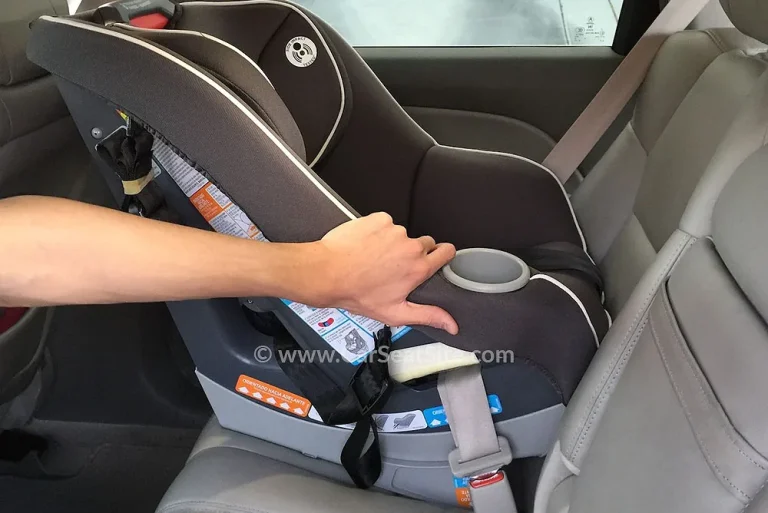
Many parents also overlook the importance of properly securing the car seat in the back seat during the earlier years. If you’re still using a booster or forward-facing seat, the back seat is the only safe place for it.
The bottom line is this: age is a useful guideline, but it’s not the only factor. You need to look at your specific child’s size and maturity level before making the switch.
Why the Back Seat Is the Safest Spot for Every Child Under 13
The back seat has been the safest place for children since the 1990s when passenger airbags became standard. The science is straightforward. A front airbag is designed to protect an adult-sized body.
When a child sits in the front, the airbag may hit them in the head or neck instead of the chest.
NHTSA estimates that keeping children under 13 in the back seat reduces the risk of serious injury by about 30 percent. That’s a significant number when you consider that car crashes are a leading cause of death for children in the United States.
Here are the main reasons the back seat wins every time:
- Airbag distance: The front seat is closer to the dashboard, where the airbag deploys
- Body size: Children’s bones are still growing and more vulnerable to impact
- Seat belt geometry: The back seat has a more natural belt fit for smaller bodies
- Crash forces: Rear seats absorb less of the impact in a frontal collision
- No airbag override: Most vehicles don’t have a passenger airbag on/off switch
You might be thinking about keeping the car seat clean and well-maintained during those years in the back seat. That’s a smart move, and it’s worth checking out tips for handling spills and stains so your child’s seat stays in good condition.
The back seat is also safer because it keeps children away from the dashboard. In a crash, the dashboard can intrude into the passenger space. The back seat has more distance between the child and the front of the vehicle.
The 5-Step Seat Belt Fit Test That Decides If Your Child Is Ready
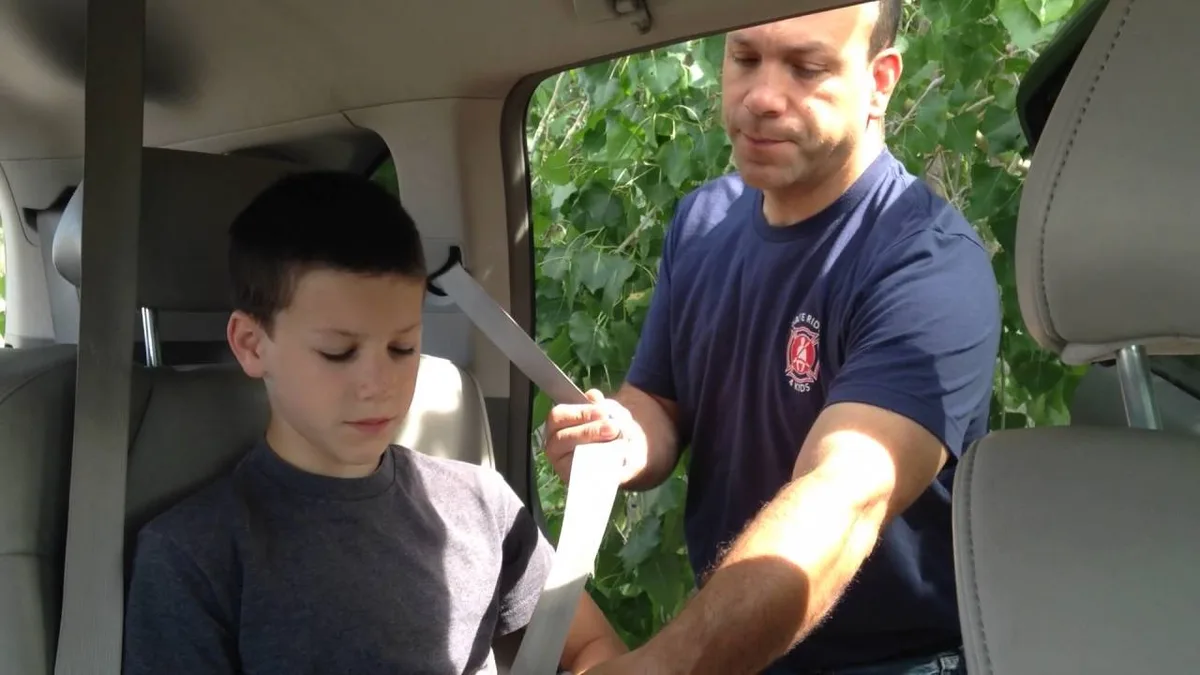
This is the single most important tool for deciding if your child can move to the front seat. The 5-step seat belt fit test comes from NHTSA and child passenger safety technicians. It’s simple, but it’s accurate.
If your child fails even one of these steps, they need to stay in the back seat with a booster seat.
Step 1: Check the knee bend
Your child’s knees should bend at the edge of the seat with their back against the seat cushion. If their legs are too short and they slouch, the belt won’t fit properly.
Step 2: Lap belt position
The lap belt must sit low on the hips, touching the tops of the thighs. It should never rest on the stomach. A stomach-positioned belt can cause internal organ damage in a crash.
Step 3: Shoulder belt position
The shoulder belt should cross the center of the chest and rest on the collarbone. It must not touch the neck or face. If it does, the child is too small.
Step 4: Proper posture
Your child must be able to sit with their back flat against the seat for the entire ride. No slouching, no leaning forward, no moving the belt behind their back or under their arm.
Step 5: Feet flat on the floor
Both feet must be flat on the floor. If your child’s legs are dangling, they can’t sit properly and may slide forward in a crash.
If you’re still using a booster seat in the back, you’ll want to know how to maintain it properly. If your child passes all five steps, they can ride without a booster. But the back seat is still safer until they’re 13.
State Laws vs. Safety Guidelines: What You Legally Need to Know
State laws are the minimum requirement. Safety guidelines are the best practice. They are not the same thing.
Every state has its own child passenger safety laws. Some states say children must be at least 8 years old to sit in the front. Others say 12.
A few states don’t have a specific age law at all and only require a proper seat belt fit.
Here’s a quick look at how state laws typically break down:
| Factor | Common State Law | NHTSA Recommendation |
|---|---|---|
| Minimum age | 8 to 12 years old | 13 years old |
| Height requirement | 4 feet 9 inches (common) | 4 feet 9 inches |
| Weight requirement | 80 to 100 pounds (common) | 80 to 100 pounds |
| Booster seat requirement | Up to age 8 to 12 | Until passing 5-step test |
| Front seat restriction | Varies widely | Keep in back seat until 13 |
The problem is that some states only require a seat belt to be worn. They don’t have a specific front seat age. That means you could legally put a 7-year-old in the front seat in some states, but it would not be safe.
Your state’s law tells you what you must do. Safety guidelines tell you what you should do. Always follow the stricter rule.
If you’re traveling with a rental car, you’ll want to know about car seat options before you arrive. Many rental companies offer car seats, but availability varies. Planning ahead can save you a lot of hassle.
Decision Tree: Is Your Child Ready for the Front Seat?
This is the part where you actually figure out the answer for your specific child. Use this decision tree like a flowchart. Start at the top and work your way down.
Step 1: Is your child under 13?
Yes: Keep them in the back seat. Move to Step 2 only if you have no back seat (single cab truck, etc.).
No: Move to Step 2.
Step 2: Has your child passed the 5-step seat belt fit test?
Yes: Move to Step 3.
No: Keep them in the back seat with a booster. Do not use the front seat.
Step 3: Does your state have a minimum age requirement?
Yes: Check your state’s age law. If your child is under that age, they cannot legally sit in the front.
No: Move to Step 4.
Step 4: Does your vehicle have a passenger airbag?
Yes: Move to Step 5.
No (rare in modern vehicles): The front seat is safer, but still not ideal for children under 13.
Step 5: Can you slide the front seat as far back as possible?
Yes: Move to Step 6.
No: The front seat is too close to the dashboard. Keep the child in the back.
Step 6: Final check
Your child must sit properly for the entire ride. No leaning, no slouching, no playing with the belt. If you can’t trust them to sit still, they’re not ready.
If you answer yes to all of these, your child can ride in the front seat. But remember: the back seat is still the safest place. Even if your child is ready, keeping them in the back until they outgrow it is the best choice.
For families who travel frequently, finding a car seat for a rental car can be a challenge. Some rental companies offer them, but you can also bring your own. Just make sure it’s installed correctly before you drive off.
The decision tree isn’t complicated, but it requires honesty. If your child is close to passing but not quite there, they need more time in the back seat. A few extra months in a booster is a small price to pay for their safety.
The Airbag Risk Most Parents Don’t Think About
You already know airbags can hurt a child. But the specifics might surprise you. A front passenger airbag deploys with enough force to break a child’s neck or cause traumatic brain injury.
The danger is worst for children under 13 because their bodies are still developing. Their heads are larger relative to their bodies. Their necks are weaker.
Their chests are not fully ossified. An airbag hitting a child in the head or neck is much more dangerous than hitting an adult in the chest.
Here’s what happens in a crash. The airbag sensor detects the impact. The airbag inflates in about 30 milliseconds at roughly 200 miles per hour.
If a child is sitting too close to the dashboard, the airbag hits them at full force before it has time to deflate.
The risk is especially high for children who:
- Are shorter than 5 feet tall
- Sit with their face close to the dashboard
- Lean forward to adjust the radio or look at the driver
- Sit in a vehicle with an older, single-stage airbag
Modern vehicles have advanced airbag systems that detect passenger weight and position. But these systems are not foolproof. A child who is borderline in size may not trigger the sensors correctly.
The airbag may still deploy with full force.
The safest approach is simple. Keep all children under 13 in the back seat. If you must put a child in the front, slide the seat as far back as possible.
The distance between the child and the dashboard is your only real protection.
When You Have No Choice: Trucks, Small Cars, and Ride-Hailing

Some vehicles don’t have a back seat. Single-cab pickup trucks and some two-seater sports cars are the most common examples. In these cases, you have no choice but to put your child in the front seat.
The same rules apply, but they are even more important. Your child must meet the height and weight requirements. They must pass the 5-step seat belt fit test.
And you must disable the passenger airbag if your vehicle has a switch.
Not all vehicles have an airbag on/off switch. If yours doesn’t, you have a harder decision. Some vehicles from the 1990s and early 2000s have a manual switch.
Newer vehicles typically use automatic sensors that detect passenger weight. If your vehicle has a manual switch, use it. Turn the airbag off when a child is in the front seat.
Ride-hailing and taxis present another tricky situation. Uber and Lyft policies generally follow state laws. But the driver may not have a car seat.
You are responsible for your child’s safety.
If you’re using a ride-hailing service with a child, here’s what to do:
- Bring your own car seat or booster seat
- Request a vehicle with a back seat
- Sit in the back with your child if possible
- Check that the seat belt fits properly
- Never rely on the driver to have the right equipment
Rental cars are another situation where you might not have a choice. Some rental companies offer car seats, but they are often expensive and may not be properly maintained. Bringing your own is almost always better.
Common Mistakes Parents Make When Moving Kids to the Front Seat
Parents want their kids to be safe. But mistakes happen. Here are the most common ones we see in our research.
Mistake 1: Moving too early based on age alone
The most common error. A child turns 12 and suddenly they’re in the front seat. Age is a guideline, not a guarantee.
Size and seat belt fit matter more.
Mistake 2: Letting the child control the seat belt
Children will put the shoulder belt behind their back or under their arm. They do this because it’s more comfortable. It is also extremely dangerous.
In a crash, the belt won’t hold them. They can slide forward and hit the dashboard.
Mistake 3: Ignoring the booster seat
Some parents stop using a booster seat too early. The child looks big enough. But the seat belt doesn’t fit properly.
Keep your child in a booster seat until they pass the 5-step test.
Mistake 4: Assuming the front seat is safe because the airbag is off
An airbag off switch helps, but it doesn’t solve everything. The front seat is still closer to the dashboard. The seat belt geometry is different.
The back seat is always safer.
Mistake 5: Not checking the vehicle owner’s manual
Your car’s manual has specific instructions about child passengers. Some vehicles have different rules for different seats. Check the manual before you make any decisions.
Mistake 6: Forgetting about posture
A child who slouches or leans forward is not properly restrained. Even if the belt fits when they sit straight, it won’t work if they move. Teach your child to sit properly for the entire ride.
How to Properly Move a Child to the Front Seat (Step by Step)
If you’ve decided your child is ready for the front seat, do it the right way. Follow these steps exactly.
Step 1: Check your vehicle owner’s manual
Look for the section on child passenger safety. Some vehicles have specific restrictions or requirements for the front passenger seat.
Step 2: Adjust the front seat
Slide the seat as far back as possible from the dashboard. The goal is to maximize the distance between your child and the airbag. This is the single most important adjustment you can make.
Step 3: Perform the 5-step seat belt fit test
Run through the test one more time in the front seat. The belt geometry is different from the back seat. Make sure it still fits properly.
Step 4: Check the airbag status
If your vehicle has a passenger airbag on/off switch, turn it off. If it has an automatic sensor, make sure the airbag status indicator shows the airbag is off. If the airbag is active and your child is small, do not use the front seat.
Step 5: Teach your child proper posture
Show them how to sit with their back against the seat. Tell them to keep their feet flat on the floor. Explain why they should never lean forward or move the belt.
Step 6: Do a trial run
Take a short drive with your child in the front seat. Watch their posture. Check that they stay seated properly.
If they can’t do it, they’re not ready.
Step 7: Monitor regularly
As your child grows, the seat belt fit may change. Check the fit every few months. Adjust the seat position as needed.
What to Do If Your Child Is Not Ready for the Front Seat Yet
This is the most common situation. Your child wants to sit in the front. Their friends already do.
But they’re not ready. Here’s what you can do.
First, explain why. Tell your child that the front seat is not safe for them yet. Use simple language.
Show them the seat belt test. Let them see that the belt doesn’t fit properly. Most children will understand when they see the evidence.
Second, set a clear goal. Tell your child what they need to reach. A specific height.
A specific weight. Passing the seat belt test. Give them something to work toward.
Third, find alternative ways to make them feel grown up. Let them help with navigation. Let them choose the music.
Let them have a special responsibility in the car. These small changes can make a big difference.
Fourth, be consistent. Don’t give in to pressure. Not from your child.
Not from other parents. Your child’s safety is more important than anyone’s opinion.
If you’re dealing with a messy car seat in the meantime, keep it clean and well-maintained. A clean seat is more comfortable and lasts longer.
FAQ: Quick Answers to the Most Common Questions
What is the legal age for a child to sit in the front seat?
There is no single federal law. Each state sets its own minimum age, usually between 8 and 12 years old. Check your state’s specific requirements.
Safety experts recommend waiting until at least 13 regardless of what the law says.
Can a child sit in the front seat with a booster seat?
No, you should not use a booster seat in the front seat if the vehicle has an active passenger airbag. The booster lifts the child closer to the airbag deployment zone. The back seat is the only safe place for a booster.
What if my car doesn’t have a back seat?
If your vehicle has no back seat, you must put your child in the front. Disable the passenger airbag if your vehicle has a manual switch. Slide the seat as far back as possible.
Follow the 5-step seat belt fit test strictly.
How do I know if my child is tall enough for the front seat?
Your child should be at least 4 feet 9 inches tall. They must sit with their back against the seat and their feet flat on the floor. The shoulder belt must cross the center of their chest, not their neck or face.
Can my 12-year-old sit in the front seat?
A 12-year-old can sit in the front seat only if they pass the 5-step seat belt fit test and your state allows it. But the back seat is still safer. If you have a back seat, keep them there until they turn 13.
Final Verdict: The Safest Way to Decide for Your Child
The answer to “when can kids sit in front seat of car” comes down to three things. Age, size, and seat belt fit. The safest rule is simple.
Keep all children under 13 in the back seat. If they are 13 or older, run the 5-step seat belt fit test. If they pass, they can sit in the front.
If they fail, they need more time in the back.
State laws give you the minimum. Safety guidelines give you the best practice. Always follow the stricter rule.
Your child’s safety is worth waiting a few extra months or years. When in doubt, keep them in the back seat. It is the single best decision you can make.